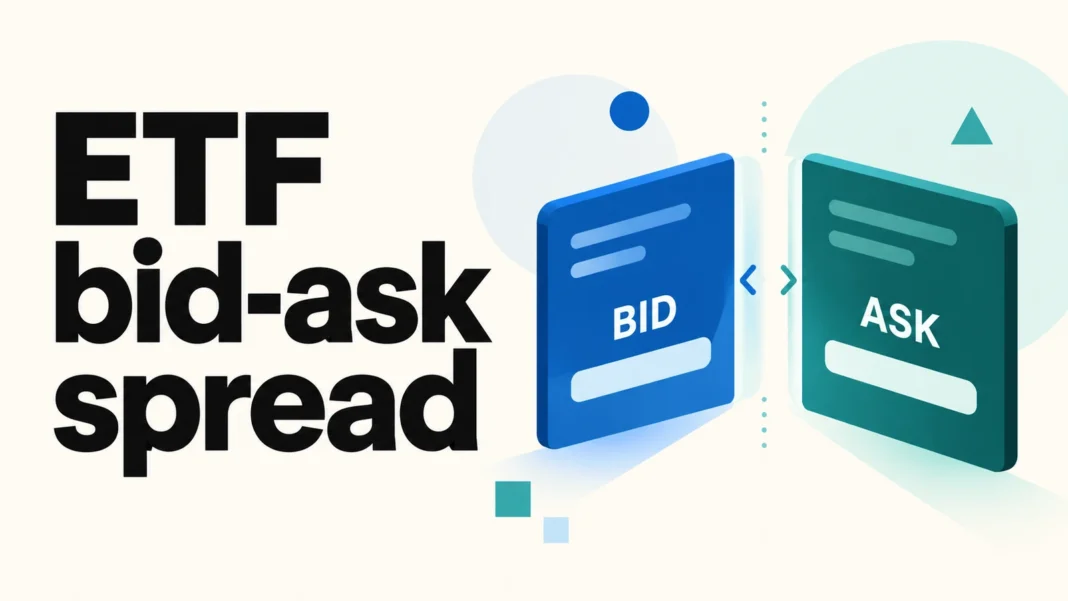

The ETF bid-ask spread is the gap between the highest quoted buying price and the lowest quoted selling price. It affects the price you receive when trading, even when your broker charges no commission. Unlike the expense ratio, the spread is a trading cost rather than an annual fund charge.
To understand its impact, compare the bid and ask at the same moment, express the difference as a percentage of their midpoint, and distinguish a single trade from a round trip. A published historical spread can provide context, but it cannot promise the price of your next order.
What the bid and ask mean
Suppose an ETF quote shows a bid of $49.95 and an ask of $50.05. The bid represents an available buying price; someone selling into it would receive $49.95 per share. The ask represents an available selling price; someone buying at it would pay $50.05. The gap is $0.10 per share.
The SEC’s ETF investor bulletin explains these two prices and how crossing the spread can reduce an investor’s return. Desinance’s introduction to ETFs provides broader background on the fund structure.
A quote is a snapshot. It can change before an order reaches the market, and the displayed price may cover fewer shares than the order requires. Do not treat the last traded price as a substitute for the current bid and ask.
Calculate the ETF bid-ask spread in dollars and percent
The following figures are hypothetical, not a quote for an actual fund. Assume enough shares are available at the displayed prices and ignore commissions, taxes, currency conversion, market movement, and other execution effects.
- Bid: $49.95.
- Ask: $50.05.
- Dollar spread: $50.05 − $49.95 = $0.10.
- Midpoint: ($50.05 + $49.95) ÷ 2 = $50.00.
- Percentage spread: $0.10 ÷ $50.00 × 100 = 0.20%.
Using the midpoint makes the percentage denominator explicit. The SEC’s ETF rule release also describes a midpoint-based calculation for the U.S. median spread disclosure. Check the methodology when comparing figures from different sources.
For 100 shares, a purchase at the ask costs $5,005. An immediate sale of those same shares at the unchanged bid returns $4,995. The hypothetical round-trip difference is $10, or one full $0.10 spread multiplied by 100 shares.
Why one-way cost is different from a round trip
Measured against the $50 midpoint, the buyer pays $0.05 extra per share, or $5 for 100 shares. The seller receives $0.05 less per share, another $5 relative to that same midpoint. These two halves explain the $10 round-trip difference.
It would be misleading to charge the full $10 spread to the purchase alone and then charge another full $10 to the sale in this unchanged-quote example. It would also be misleading to promise that a real order will incur exactly half the quoted spread. Execution inside the spread, changing quotes, order size, and other conditions can change the outcome.
When recording an estimate, name the benchmark. “About $5 above the midpoint on this purchase” conveys more than “the fee is $5.” The spread normally appears through the execution price, rather than as a separate spread line on an account statement.
Spread, expense ratio, and premium are separate comparisons
Vanguard’s investment-cost guide distinguishes fund expenses, trading spreads, and broker commissions. A low expense ratio does not tell you the price available for a trade, while commission-free trading does not remove the spread.
- Expense ratio: ongoing operating expenses expressed as an annual percentage of fund assets.
- Bid-ask spread: the difference between the two quoted sides of the market at a particular moment.
- Broker charges: commissions or other account and transaction charges, where applicable.
- Premium or discount: the relationship between an ETF’s market price and its net asset value per share.
The last comparison uses a different reference point. A tight spread does not establish that the market price equals net asset value. Likewise, a premium is not the same thing as the gap between bid and ask. Read the fund’s valuation and premium/discount information alongside its trading-cost information.
Where to find published ETF bid-ask spread information
Look on the issuer’s official fund page for trading information, spreads, and premiums or discounts. As an example of the location, the iShares EFA page includes a 30 Day Median Bid/Ask Spread field. This is a disclosure example, not a fund recommendation or a statement about its current value.
For ETFs relying on U.S. Rule 6c-11, the SEC specifies a website median spread calculation using national best bid and offer observations over the preceding 30 calendar days. That is a historical summary. A median is the middle observation in an ordered set, not a guarantee, maximum, or live quote. Disclosure requirements and conventions differ across jurisdictions and product structures.
Record the observation date, fund share class, listing, trading currency, and measurement period. A figure copied without those details may not describe the instrument or conditions you intend to compare.
Use the order screen to check execution choices
A market order prioritizes execution at available prices. A limit order sets a maximum purchase price or minimum selling price. Investor.gov’s order guide explains these distinctions and warns that a limit order may never execute.
A limit at the midpoint does not entitle you to a midpoint fill. Someone must be willing to trade at that price, and the market may move away. Review the order’s duration and any unfilled quantity rather than repeatedly changing it without understanding the consequences.
Before submitting, check whether the quote is current or delayed, whether regular trading is open, and how many shares the displayed prices cover. For an unfamiliar order type or a large order relative to available quotes, ask the broker how execution works. These are process checks, not a prediction that a particular trading time or order will produce a better result.
A short comparison checklist
- Confirm the exact ETF, listing, currency, and investment exposure.
- Read the prospectus for objectives, risks, expenses, and relevant charges.
- Compare bid and ask from the same timestamp.
- Calculate the dollar spread and percentage using a stated denominator.
- Keep one-way estimates separate from hypothetical round-trip costs.
- Compare historical spread information with the current quote without treating them as interchangeable.
- Review the order type, price limit if used, duration, and broker charges.
The ETF bid-ask spread is one part of the cost of owning and trading a fund. Understanding the calculation helps explain a quote; it does not determine whether the fund suits your goals or eliminate investment risk. This article provides general education rather than personalized investment advice.