
The AI Revolution Every Business Leader Must Grasp
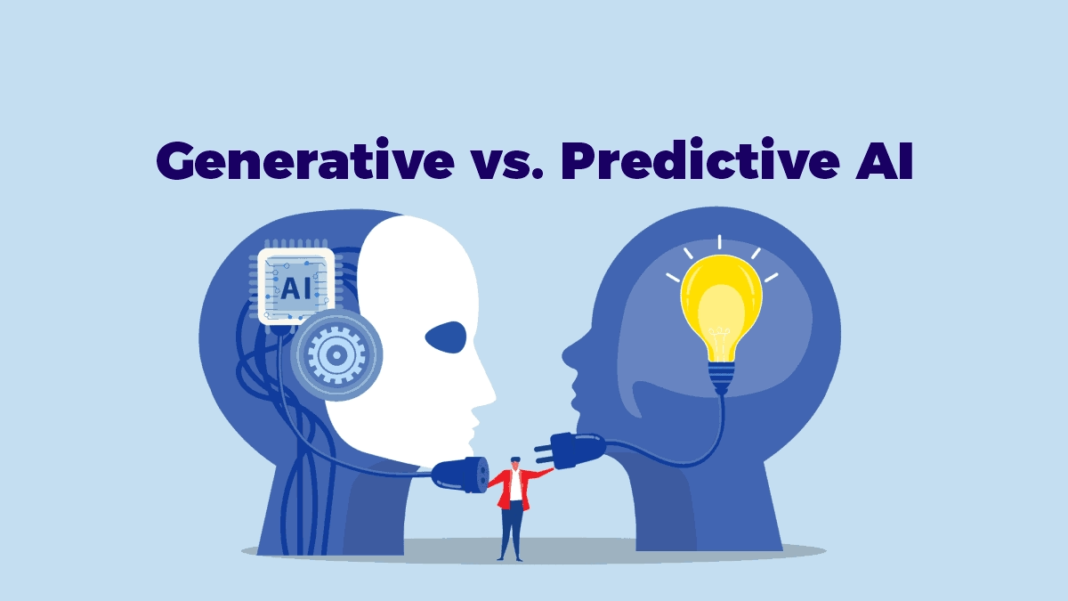
Artificial intelligence (AI) is rapidly reshaping business operations, from customer engagement to strategic forecasting. Yet, not all AI is created equal. When leaders ask Generative vs. Predictive AI, they’re not seeking semantics, they’re trying to understand how different forms of AI can create value, reduce risk, and drive competitive advantage. In this article, you’ll discover the core differences, real-world examples, and actionable insights for leveraging these technologies in 2026 and beyond.
Let’s start with fundamental definitions, right up front, because Generative vs. Predictive AI shapes your AI strategy.
Understanding What Each AI Type Actually Is
What Is Generative AI? (And How It Works)
Generative AI refers to systems that create entirely new content, text, images, audio, video, code, and more by learning patterns from vast datasets. This output didn’t exist before and isn’t just a repetition of existing examples. Examples include tools like ChatGPT, Gemini, and image generators such as DALL-E that respond to prompts with novel outputs.
Technically, generative models are trained on unlabeled data and use architectures like transformers or generative adversarial networks (GANs) to produce new artifacts.
Example outputs include:
- Natural-language text (blog posts, emails, FAQs)
- Visual assets (product images, branding mockups)
- Multimedia (audio, video clips)
- Software code and designs
Because generative AI models work by learning deep patterns rather than simply regurgitating data, they often produce creative and high-variety outputs.
What Is Predictive AI? (The Forecasting Engine)
Predictive AI, in contrast, uses historical and structured data to estimate future outcomes or behaviors. It’s about foresight, not creation. Typical predictive tasks include forecasting customer churn, predicting equipment failures, or estimating sales demand based on patterns in historical datasets.
Predictive models are usually based on statistical machine learning algorithms – regression, decision trees, time-series forecasting, and random forests – trained on labeled datasets where outcomes are previously known.
Example outcomes include:
- Sales forecasts
- Customer behavior predictions
- Risk scoring and fraud detection
- Inventory demand projections
Unlike generative AI, predictive AI does not create new artifacts; it uses data to anticipate what will happen next.
Why the Difference Matters to Business Strategy
Generative AI Benefits for Businesses
Generative AI unlocks creativity at scale, enabling businesses to:
- Automate content production: generate blogs, ads, and social media posts instantly
- Enhance personalization: tailor marketing copy and product experiences
- Accelerate design ideation: produce prototypes, graphics, and mockups
- Reduce operational costs: quickly generate routine deliverables
This makes generative AI especially powerful for marketing, branding, customer experience, and early-stage product innovation.
Key point: Generative AI is a creator, it generates fresh content and ideas, filling executive time and boosting productivity.
Predictive AI Benefits for Business Decisions
Predictive AI strengthens a company’s decision-making and risk management capabilities:
- Helps forecast sales and plan inventory
- Alerts teams to customers likely to churn
- Supports dynamic pricing strategies
- Assesses financial risk and credit scoring
This makes predictive AI vital for operations, finance, supply chain planning, and customer analytics.
Key point: Predictive AI is a forecaster, it offers evidence-based insight into future outcomes.
Generative vs. Predictive AI Examples in Practice
Here are concrete examples showing both AI types at work:
| AI Type | Real-World Example | Business Use Case |
|---|---|---|
| Generative AI | ChatGPT generates customer FAQs | Marketing & Support content automation |
| Generative AI | AI generates product images for ads | Creative asset generation |
| Predictive AI | Sales forecasting model predicts next quarter revenue | Finance & operations planning |
| Predictive AI | Machine learning churn model identifies at-risk customers | Retention & CRM strategy |
These examples illustrate how each AI type solves different business challenges, even though both fall under the broader AI umbrella.
Generative AI vs. Predictive AI vs. Machine Learning
It’s common to confuse these terms, but they represent related yet distinct concepts:
- Machine Learning (ML): A broad category of algorithms that learn patterns from data. Both generative and predictive AI use ML techniques.
- Generative AI: ML-powered models focused on creating new content.
- Predictive AI: ML models focused on forecasting and prediction.
In simple terms: ML is the engine; generative and predictive are the use cases.
Generative AI vs. Predictive AI vs. Agentic AI
Another emerging comparison is agentic AI: autonomous systems capable of decision-making and task execution without constant guidance.
- Generative AI creates content on demand.
- Predictive AI forecasts outcomes based on data.
- Agentic AI goes further, coordinating tasks toward a goal, adjusting and executing steps autonomously.
While agentic systems can incorporate both predictive and generative capabilities, they are a distinct class focused on action and autonomy, not just creation or forecasting.
Generative AI vs. Predictive AI vs. Conversational AI
Conversational AI (like rule-based chatbots) focuses on engaging users through dialogue and may use generative capabilities in some cases. However:
- Conversational AI is usually task-oriented dialogue: answering FAQs or routing support requests.
- Generative AI creates content/ideas.
- Predictive AI forecasts outcomes.
Some conversational systems, like advanced chatbots, combine generative techniques with predictive analytics to anticipate user needs.
Is ChatGPT Generative AI or Predictive AI?
ChatGPT is primarily generative AI, it generates text and responses based on patterns learned during training. While its internal mechanism involves sequence prediction to decide the next word, its purpose is to create new text/content rather than forecast future events.
People Also Asked (FAQ)
What are the 4 types of AI?
Core categories include descriptive, predictive, generative, and prescriptive AI. Other frameworks include reactive machines, limited memory, theory of mind, and self-aware AI – but these are broader classifications. (Context based on widely accepted AI taxonomies).
Which is better, AI or AGI?
AI refers to narrow intelligence solving domain tasks. AGI (Artificial General Intelligence) describes AI capable of human-like reasoning across domains. AGI remains theoretical and is not yet realized.
What is the difference between generative AI and other AI?
Generative AI is specifically focused on creating new outputs, whereas other AI types (like predictive, diagnostic, or recommender systems) focus on insight, classification, and decision support.
Generative AI vs Predictive AI examples?
- Generative: Creating product descriptions or artwork.
- Predictive: Forecasting customer buying patterns or demand.
Can businesses combine generative and predictive AI?
Yes – the most effective AI strategies integrate both: predictive AI informs what might happen, and generative AI automates responses or creative outputs tied to those insights.
Expert Video Insight
Video Summary: This expert walkthrough explains distinctions between generative AI, predictive AI, and agentic systems – clarifying how each impacts business workflows. It’s especially useful for executives weighing AI investments, because it frames technical differences in real-world scenarios.
Implementing AI in Your Business
Strategic Recommendations
- Map business goals to AI types
- Need content and creativity? Prioritize generative AI.
- Need forecasting and planning? Deploy predictive models.
- Build cross-functional AI workflows
Combine predictive insights with generative execution to automate intelligent responses. - Invest in data quality and governance
High-quality training data increases predictiveness and generation relevance. - Measure impact and ethical risk
Track AI outcomes and ensure outputs align with brand values and compliance.
Choose the Right AI for the Right Task
Understanding Generative vs. Predictive AI enables business leaders to allocate resources wisely, boost innovation, and future-proof operations. Whether you’re optimizing forecasting with predictive analytics or scaling creative output with generative models, both technologies offer transformative power – especially when used in concert.