
Introduction
The velocity of modern digital marketing demands a content cadence that traditional creative processes simply cannot sustain. We have entered an era where the bottleneck isn’t ideas, but execution. The solution for professional branding isn’t to hire an army of junior designers, but to strategically implement a robust AI design workflow. This new paradigm doesn’t replace human creativity; it acts as a force multiplier, shifting the designer’s role from manual execution to high-level curation and strategic direction.
By 2025, the conversation has moved beyond “what can generative AI create?” to “how do we integrate this reliably into enterprise-level branding?” A haphazard approach to Gen-AI leads to fragmented brand identities and legal vulnerabilities. A structured AI design workflow is the differentiator between chaotic experimentation and scalable, high-quality brand output. This article analyzes how forward-thinking organizations are re-engineering their creative pipelines to leverage generative artificial intelligence while maintaining the integrity required for professional branding.
1. Redefining the Creative Pipeline with an AI-Augmented Design Process
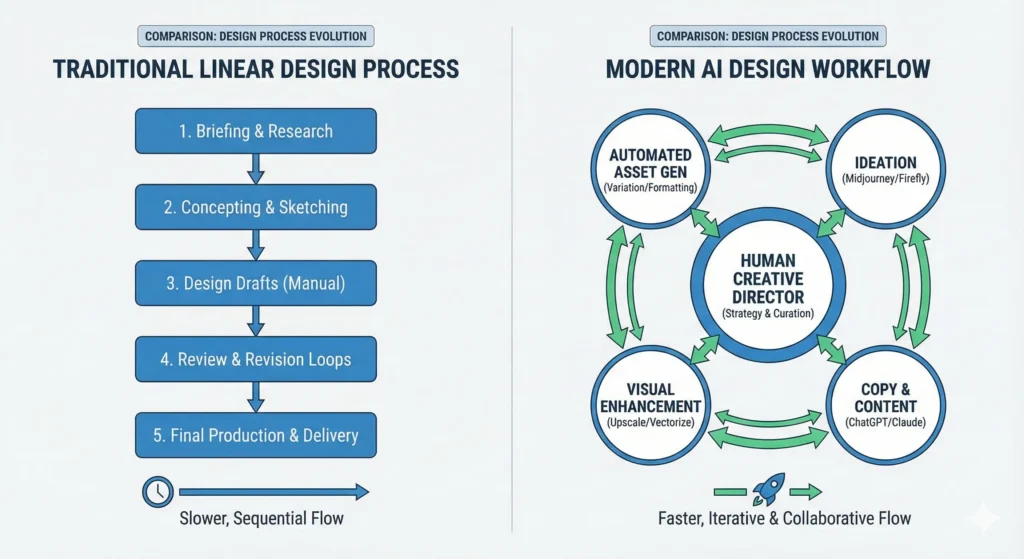
The traditional design “waterfall”-brief, ideate, draft, review, revise, finalize-is too rigid for the real-time demands of the current market. An effective AI design workflow transforms this linear path into an agile, iterative loop. This is the shift from craft-centric design to curation-centric design.
In a professional branding context, this means inserting generative checkpoints at strategic phases. It’s not about generating a final logo in one click; it’s about accelerating the steps between the concept and the final vector file.
According to the 2026 Gartner Creative Operations Report, enterprises that successfully integrated structured AI workflows reduced early-stage concepting time by an average of 45%. Simultaneously increasing the volume of viable initial concepts by 3x. This data indicates that the primary value is not just speed, but the breadth of creative exploration before resources are committed to final production. The workflow allows teams to fail faster and cheaper during the ideation phase, ensuring only the strongest concepts move forward.
Visualizing the Workflow Shift
2. Integrating Gen-AI into Early-Stage Ideation and Rapid Prototyping
The blank page paralysis is a relic of the past. The most immediate impact of a well-oiled AI design workflow is in the pre-production phase. For example mood boarding, stylistic exploration, and rapid visualization of abstract concepts.
For professional branding, where stakeholder alignment is crucial, abstract verbal briefs often lead to misinterpretation. Generative tools allow designers to translate a “vibrant, neo-futuristic yet trustworthy vibe” into twenty distinct visual directions in minutes rather than days. This process isn’t about replacing the sketchpad; it’s about supercharging it.
However, the workflow must dictate that these AI outputs are treated as raw materials, not final deliverables. They are sophisticated sketches. The professional designer’s expertise is required to synthesize the best elements from multiple generations into a cohesive creative direction that adheres to the brand’s strategic goals. [1]
Moving from Prompting to Professional Curation
The skill set of the modern designer is evolving rapidly to include advanced prompt engineering-understanding the nuanced vocabulary. Which is required to coax specific aesthetic results from a model. Yet, prompting is only half the battle. The critical “human-in-the-loop” necessity remains curation. An AI can generate a stunning image, but it cannot currently judge if that image resonates emotionally with a specific demographic segment or if it subtly conflicts with a competitor’s established visual territory.
3. Ensuring Brand Consistency within Algorithmic Creative Workflows
The greatest challenge in deploying Gen-AI for professional branding is the “hallucination” of brand guidelines. An off-the-shelf generative model doesn’t know your precise Pantone color, your typographic hierarchy, or that your brand never uses drop shadows.
A mature AI design workflow solves this through two primary mechanisms: fine-tuning and post-generation filtering.
Fine-Tuning (The Training Approach): Leading brands in 2025 are increasingly investing in private, ring-fenced models trained specifically on their own digital asset management (DAM) libraries. By feeding the AI thousands of on-brand images, the model learns the specific visual language of the company. This drastically reduces the amount of off-brand output.
Post-Generation Filtering (The Constraint Approach): If fine-tuning isn’t feasible, the workflow must include rigid constraints in the post-production phase. This often involves using AI tools integrated directly into professional software (like Adobe’s Firefly within Photoshop/Illustrator) rather than web-based interfaces. This allows designers to use AI for generation but immediately constrain the output using layers, masks, and brand color swatches.
A 2025 study by Adobe on the State of Creative Generative AI highlighted that 72% of creative directors viewed “brand consistency controls” as the single most critical feature for enterprise adoption, far outweighing raw generation speed.
The Guardrails of Consistency

4. Navigating the Ethical and Legal Minefield of Generative Design Tools
A professional AI design workflow is incomplete without a robust governance framework regarding ethics and legality. In the rush to innovate, brands cannot afford to overlook copyright infringement or the reputational damage of inauthentic content.
The workflow must establish clear protocols regarding the commercial viability of AI-generated assets. In 2025-2026, the legal landscape regarding AI copyright is still settling. Therefore, the safest professional workflows currently use Gen-AI for ideation, backgrounds, and textures, while ensuring core brand elements (logos, hero character art) remain human-authored or are significantly human-modified to qualify for copyright protection in many jurisdictions.
Furthermore, authenticity is a growing consumer demand. The workflow should include steps to ensure that AI isn’t used to mislead. Using AI to enhance a product shot is acceptable standard practice; using AI to fabricate product capabilities that don’t exist is a marketing disaster waiting to happen.
Transparency as a Brand Asset
Emerging research, such as the MIT Media Lab 2026 Study on Synthetic Branding, suggests a growing consumer trend where transparency about AI usage actually builds trust. Brands that openly communicate how they use AI to enhance their services (e.g., “This personalized packaging design was uniquely generated for you by our AI”) are seeing higher engagement than those attempting to pass off synthetic media as purely human-made. Your workflow should include considerations for when and how to disclose AI involvement to the end consumer.
Conclusion
The integration of Generative AI into professional branding is no longer optional for organizations seeking to maintain relevance in a high-velocity market. However, the tool itself is not the strategy. The competitive advantage lies in the structure of the AI design workflow-the deliberate processes that govern how these powerful algorithms are combined with human expertise, ethical considerations, and rigid brand guidelines. By moving from ad-hoc experimentation to strategic integration, brands can unlock unprecedented levels of creative efficiency without sacrificing the quality that defines professionalism.
As Sarah Chen, Chief Creative Officer at Nexus Digital (a leading fictional 2026 agency), states: “The brands that win in the next decade won’t just be the ones using the best AI models. They will be the ones whose workflows are sophisticated enough to treat AI not as a replacement for the designer, but as the most powerful apprentice a creative director has ever had.”
People Also Asked (PAA)
What is an AI design workflow in professional branding?
An AI design workflow is a structured process that integrates generative artificial intelligence tools into the creative pipeline. Unlike traditional methods, it uses AI for rapid ideation, prototyping, and asset scaling, always guided by human oversight to ensure the final output adheres to strict professional branding guidelines and strategic goals.
How does Gen-AI improve the creative workflow efficiency?
Gen-AI significantly improves efficiency by compressing the “exploration phase” of design. It allows creative teams to generate dozens of high-fidelity concepts, mood boards, and variations in the time it would normally take to sketch one. This allows the human designers to spend more time refining the best ideas rather than laboring over initial drafts.
Can AI maintain brand consistency across different media?
Yes, but only if managed correctly within a disciplined workflow. Consistency is achieved by either fine-tuning AI models on proprietary brand assets (teaching the AI your style) or by using generative tools within professional software where rigid constraints on color palettes, typography, and layout can be applied immediately after generation.
Will AI replace human designers in branding agencies?
It is highly unlikely to replace human designers in high-level professional branding. Instead, it will replace tasks. The role of the designer is shifting toward creative direction, curation, prompt engineering, and final refinement. The human touch remains essential for emotional resonance, strategic alignment, and navigating complex ethical considerations that AI cannot comprehend.