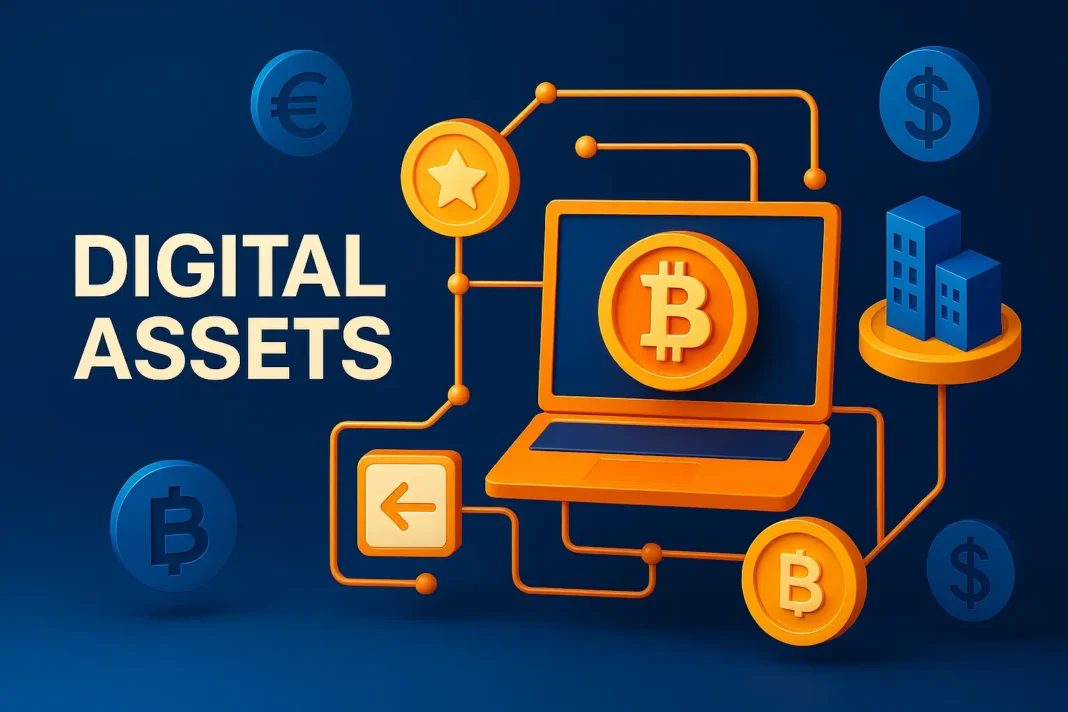

Digital Assets are transforming how value is created, transferred, and stored across the internet-from cryptocurrencies and stablecoins to tokenized bonds and fund shares. In this guide, we unpack the spectrum of Digital Assets-what they are, how they work, why regulators care, and how tokenization could reshape capital markets. (Primary keyword in first 100 words: Digital Assets.)
Definition (plain English): A digital asset is a uniquely identifiable electronic record that can be controlled and transferred using cryptography and distributed systems-covering crypto-assets (like Bitcoin), tokens with specific rights (like stablecoins or utility tokens), and tokenized versions of traditional assets (like bonds or fund shares on a blockchain). [cftc.gov]
Digital Assets 101: Crypto vs. Tokens vs. Tokenized Assets
Crypto-assets. Cryptocurrencies (e.g., Bitcoin) and other “unbacked” tokens exist natively on blockchains and do not represent claims on underlying assets. Global prudential standards (Basel/BIS) classify these separately from tokenized collateral or stablecoins, with stricter capital treatment for unbacked assets. [pwc.ch]
Stablecoins and tokenized deposits. Tokens designed to maintain stable value (e.g., asset-referenced tokens or e-money tokens) and bank-issued tokenized deposits are intended to act as settlement instruments, subject to bespoke regulatory safeguards due to their payment and systemic roles. [globalgove…intech.com], [esma.europa.eu]
Tokenized assets (real-world assets, or RWAs). These are on-chain representations of traditional financial instruments-bonds, fund shares, repos, and collateral-often issued on distributed ledger technology (DLT). International bodies (FSB, OECD) note rising pilots but limited large-scale adoption so far, with clear benefits in efficiency and programmability. [fsb.org], [oecd.org]
Why it matters. The Bank of England and other central banks view tokenization and programmable ledgers as potential innovations in money and payments-provided key principles like the “singleness of money” and settlement finality are preserved. [bankofengland.co.uk], [skadden.com]
The Regulatory Picture (2024-2026): From MiCA to Global Standards
EU MiCA-now fully applicable. The EU’s Markets in Crypto-Assets Regulation (MiCA) entered full application on December 30, 2024, establishing a pan-EU regime for crypto-asset issuance, stablecoins (ARTs/EMTs), and crypto-asset service providers (CASPs). Stablecoin rules kicked in earlier (June 30, 2024). Transition windows run to mid-2026 in some member states. [globalgove…intech.com], [amf-france.org], [securities…nerale.com]
Supervisory build-out. ESMA maintains an interim MiCA register of white papers and CASPs (updated Dec 23, 2025), underscoring machine-readable disclosures and consistent classification across the EU. [esma.europa.eu]
Global prudential standards (Basel/BIS). Banks must categorize exposures into tokenized traditional assets, stablecoins with effective stabilization, and other crypto-assets-each with tailored capital requirements by January 1, 2025. This clarifies risk-weighting for RWAs versus unbacked crypto. [pwc.ch]
IMF-FSB G20 roadmap. A joint status report (Oct 22, 2024) tracks global implementation of crypto-asset policy recommendations, emphasizing enforcement, cross-border coordination, and data gaps. [imf.org]
Industry taxonomy. In March 2024, the CFTC’s Global Markets Advisory Committee proposed a functional taxonomy: digital assets are controllable electronic records with exclusive transfer control. This framing helps regulators and firms align terminology across jurisdictions. [cftc.gov]
Identifiers and data standards. ISO 24165 (Digital Token Identifier) is expanding across regulatory and market infrastructures, complementing ISIN for tokenized financial instruments and aiding consistent reporting under MiCA technical standards and other regimes. [iso.org], [anna-web.org], [eur-lex.europa.eu]
Tokenization in Practice: Where the Friction-and Opportunity-Is
Capital markets pilots. Financial institutions and market infrastructures are testing tokenized funds, bonds, and repo/collateral flows. Swift’s work with global banks shows how existing infrastructure can connect to multiple blockchains, reducing fragmentation and enabling cross-chain delivery-versus-payment. [swift.com], [swift.com]
Scaling challenges. A 2024 Swift whitepaper highlights five pain points: roles/responsibilities, token standards, on-chain cash settlement, cross-chain interoperability, and reference data-urging industry collaboration to scale beyond niche pilots. [web3unplugged.io]
Public-private initiatives. Singapore’s Project Guardian (led by MAS) published a 2024 industry report and frameworks for tokenized funds and fixed income; UK’s FCA welcomed the roadmap and will work with MAS in 2025 on regulatory considerations for asset and wealth management tokenization. [fca.org.uk], [allenandgledhill.com]
Market reality (OECD & FSB). Adoption remains low but growing. Benefits (automation, fractionalization, and transparency) are clear; vulnerabilities include liquidity/maturity mismatches, leverage, and operational fragilities. Scaling safely requires robust oversight, interoperability, and credible settlement assets. [oecd.org], [fsb.org]
Risk & Compliance: What Enterprises and Investors Must Know
Custody & control. For tokenized securities in U.S. markets, the SEC’s Division of Trading and Markets issued interim staff guidance (Dec 17, 2025) explaining how broker-dealers can demonstrate “physical possession” under Rule 15c3‑3-covering private key management, DLT risk assessments, and contingency protocols. Though not binding, it’s a practical signal for the RWA sector. [sidley.com], [blockchain…kenzie.com]
Disclosure discipline. The SEC continues to press for tailored, material disclosures in crypto-related offerings-aligning white papers and promotional materials with securities filings to protect investors and market integrity. [ccn.com]
AML/CFT & market integrity. The IMF-FSB roadmap encourages consistent AML/CFT standards (aligned with FATF) and cross-border information sharing-especially as stablecoins and tokenized instruments intersect with traditional liquidity pools. [imf.org]
Data standards & identifiers. Using LEIs, DTIs, and ISINs for tokenized instruments ensures machine-readable registers and consistent classification under MiCA’s delegated regulations-critical for analytics, supervision, and market surveillance. [eur-lex.europa.eu]
Central bank priorities. The Bank of England’s 2024 discussion paper stresses preserving the “singleness of money” and settlement finality. Any expansion of tokenized deposits, stablecoins, or wholesale CBDCs must fit within a framework that keeps systems interoperable and resilient. [bankofengland.co.uk], [lexology.com]
5) Digital Assets and the 2025 Outlook: Practical Takeaways
Expect more regulated tokenization. As MiCA matures and prudential standards take effect, tokenized funds and fixed-income instruments will likely proliferate-especially where institutions can leverage existing custody, messaging, and reference-data rails. [securities…nerale.com], [swift.com]
Enterprise adoption will be phased. WEF research (2025) and Swift trials suggest that real-world adoption will proceed via interoperability layers connecting traditional systems to multiple ledgers, rather than “all-on-chain” migrations overnight. [weforum.org], [swift.com]
Data-first compliance. Firms should prepare for machine-readable disclosures (EU), robust key management and contingency planning (US), and globally recognized identifiers (ISO 24165 + ISIN) to support internal controls and external reporting. [eur-lex.europa.eu], [iso.org], [anna-web.org]
Risk lenses. Follow FSB’s vulnerability map (liquidity, leverage, asset quality, interconnectedness, operations). Pilot with clear guardrails; prioritize transparent settlement assets; track counterparty and smart-contract risks. [fsb.org]
People Also Asked
Q1: What are Digital Assets in finance?
Digital Assets are controllable electronic records secured by cryptography, including crypto-assets, stablecoins, and tokenized representations of traditional instruments (e.g., bonds, funds) that can be transferred on programmable ledgers. [cftc.gov]
Q2: How does tokenization differ from “crypto”?
Tokenization converts rights in a traditional asset into on-chain tokens; “crypto” (e.g., Bitcoin) is typically a native, unbacked digital asset. Regulators and prudential standards treat these categories differently for risk and capital rules. [pwc.ch]
Q3: Is tokenization already mainstream?
Not yet. Leading institutions report low but growing adoption, with pilots focused on funds, bonds, and collateral; scaling requires interoperability, standards, and suitable settlement assets. [fsb.org], [oecd.org]
Q4: What is MiCA and why does it matter for Digital Assets?
MiCA is the EU’s comprehensive framework governing crypto-asset issuance and services. It became fully applicable on Dec 30, 2024, with earlier rules for stablecoins, creating harmonized licensing and disclosure obligations for CASPs. [globalgove…intech.com], [amf-france.org]
Q5: What standards should firms use to identify Digital Assets?
ISO 24165 (DTI) for digital tokens, ISIN for financial instruments, and LEI for legal entities-integrated under EU delegated acts and industry MoUs to ensure unambiguous regulatory reporting. [eur-lex.europa.eu], [iso.org], [anna-web.org]
Conclusion: Navigating Digital Assets with Clarity-From Pilots to Production
Digital Assets are no longer a fringe idea-they’re a maturing set of technologies and market practices with clearer rules, better identifiers, and more pragmatic interoperability. In 2024-2025, three signals stand out:
- Regulatory clarity is advancing: EU MiCA’s full application, the IMF–FSB roadmap, and prudential standards help define obligations across issuance, custody, and disclosure. [globalgove…intech.com], [imf.org], [pwc.ch]
- Interoperability is the linchpin: Swift’s experiments and Project Guardian frameworks point to a hybrid model-connecting traditional systems to multiple ledgers while maintaining consistent data and settlement. [swift.com], [fca.org.uk]
- Risk discipline will separate leaders from laggards: Following FSB’s vulnerability map and SEC guidance on custody/disclosure will be essential as tokenized markets scale. [fsb.org], [sidley.com]
Expert Quote:
“Tokenization will succeed where institutions pair programmable assets with programmable compliance-common identifiers, machine-readable disclosures, and settlement mechanisms that preserve the singleness of money.” [eur-lex.europa.eu], [bankofengland.co.uk]
Sources (2024-2025, trusted)
- EU / ESMA / MiCA: ESMA interim MiCA register; MiCA full application notes (Dec 30, 2024); delegated acts on machine-readable classification and LEI/DTI usage. [esma.europa.eu], [globalgove…intech.com], [eur-lex.europa.eu]
- IMF-FSB: G20 Crypto-Asset Policy Implementation Roadmap (Oct 22, 2024); FSB Tokenisation financial stability report (Oct 22, 2024). [imf.org], [fsb.org]
- BIS/Prudential Standards: Basel/BIS final standards-classification and capital for tokenized assets, stablecoins, and unbacked crypto. [pwc.ch]
- OECD: Tokenisation adoption and policy considerations; supervisory approaches toolkit. [oecd.org], [oecd.org]
- Bank of England: 2024 discussion paper-innovation in money/payments and programmable ledgers. [bankofengland.co.uk], [skadden.com]
- MAS / FCA: Project Guardian-tokenized funds/fixed income frameworks; FCA’s 2024 statement and 2025 collaboration plans. [fca.org.uk], [allenandgledhill.com]
- Swift: Interoperability experiments and 2024 whitepaper on scaling tokenized assets. [swift.com], [web3unplugged.io]
- ISO / ANNA: ISO 24165 (DTI) 2025 revision; DTI-ISIN guide for tokenized instruments. [iso.org], [anna-web.org]
- SEC (US): 2025 staff guidance on custody of crypto-asset securities; disclosure expectations for crypto-related offerings. [sidley.com], [ccn.com]
- CFTC GMAC 2024: Functional taxonomy for Digital Assets as controllable electronic records. [cftc.gov]
TL;DR (for quick scanning)
- Digital Assets span crypto, stablecoins, and tokenized RWAs. Regulation (EU MiCA, IMF–FSB, BIS) is catching up fast. [globalgove…intech.com], [imf.org], [pwc.ch]
- Tokenization brings programmability and efficiency, but needs interoperability, identifiers (ISO 24165), and credible settlement assets to scale. [swift.com], [iso.org]
- Next steps: build machine-readable disclosures, adopt DTI/ISIN/LEI, design robust custody/keys policies, and join industry pilots that bridge traditional rails with multiple ledgers. [eur-lex.europa.eu], [sidley.com], [swift.com]